Shared Services Agreement Stalls: Was “Due Diligence” a Delay Tactic?
After nearly a year of discussions aimed at stabilizing Mosquito Fire’s leadership, operations, and fiscal future, the shared-services agreement with Garden Valley has been paused. Public records show a tentative August agreement, disputed revisions, and a process that may now be delayed until after the election.
There will be a public meeting on Tuesday, September 1st at 7:00 pm at Mosquito Fire Station to consider removing Director Buhnerkempe or Director Williams from the negotiation committee. Residents can come to get a better understanding of the issues, ask questions, and provide public feedback directly to the Mosquito Fire Board.
The proposed shared-services agreement was designed to provide an immediate operational bridge. Garden Valley would make Fire Chief Wes Norman available to serve as Mosquito’s fire chief, with responsibilities for administration, supervision, operations, personnel, emergency response, training, budgeting, policy implementation, regulatory compliance, and public safety. The draft contemplated a $6,500-per-month arrangement and included a provision intended to protect Mosquito’s service level at Station 75 unless the Mosquito board directed a change or funding was reduced.

Yet the shared-services agreement—assigned to Mosquito Directors Bill Buhnerkempe and Trent Williams and intended for board ratification—has stalled. The delay now raises serious questions about whether the process has met the community’s expectations for timely, transparent action, particularly as both directors seek election in 2026. The public record reflects months of discussion, unresolved revisions, and a widening gap between the urgency residents have expressed and the pace of negotiations.

A Needed Step Forward
Shared services were not presented as an abstract idea; they were a practical response to the real operational needs facing Mosquito Fire District. The two districts also have an established history of working together. Mosquito volunteers participate in the Divide Fire Academy facilitated through Garden Valley, and Garden Valley reportedly provided Mosquito with an engine at no cost earlier this year when Mosquito equipment was inoperable—helping maintain response capability during a period when the community otherwise faced increased risk.
Mosquito must optimize and stabilize its leadership, operations, and fiscal health while preserving what makes the district valuable to the community: local service, volunteer development, emergency preparedness, and a strong connection to the other fire agencies on The Divide. The question has never been whether Mosquito residents value their fire district. They do. The question is whether the district can continue operating effectively without pursuing the partnerships, administrative capacity, and long-term planning required to sustain it.
According to Director Maria Rodriguez’s August 27 issue paper, LAFCO had been attempting to bridge divisions among local districts since November 2025, while shared services were presented to Mosquito conceptually by Garden Valley in April 2026. Her account states that by late August, the district still had not begun contract negotiations in the form of a completed draft agreement, despite the urgency created by Interim Chief Bellerive’s term ending December 11, 2026.
Rodriguez’s assessment is direct: Mosquito cannot rely on avoidance, delay, or fear of change. If the district is to remain a local asset, it must actively pursue a transparent agreement that serves Mosquito residents—not allow opportunities to dissolve while the community waits for progress.
The Same Week, Two Narratives
The week of August 25 made the conflict impossible to ignore.
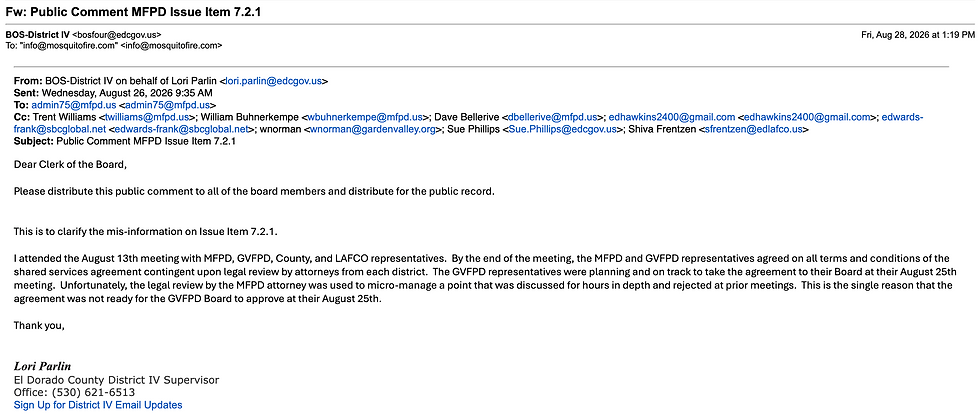
At Garden Valley Fire Protection District’s August 25 board meeting, the reported message was that Mosquito had not provided an agreement for Garden Valley to sign. Later that same week, El Dorado County Supervisor Lori Parlin reportedly stated that Mosquito had been the root cause of the stalled process.
That account stands in tension with the Mosquito Fire agenda packet prepared by Directors Trent Williams and Bill Buhnerkempe. Their August 27 “Shared Services 2x2 Meeting Readout” says a tentative agreement was reached on August 13; then, on August 17, Mosquito representatives transmitted revisions recommended by legal counsel and the district’s insurance provider. The document states that Garden Valley interpreted the changes as reopening negotiations and “going back on the agreement” made on August 13.
The Mosquito representatives’ document characterizes the August 17 revisions as standard due-diligence review rather than changes initiated by the Mosquito ad hoc team. It says Mosquito later acknowledged Garden Valley’s position on the staffing clause and was waiting for confirmation of the correct draft before final legal review.
But regardless of how the representatives characterize those edits, the outcome is clear: Garden Valley paused the agreement process, no ratification was scheduled, and discussion may not resume until the outcome of the November election is known.
That is not a minor procedural delay. It is a loss of time for a district that does not have time to lose.

Was “Due Diligence” Disingenuous?
No one should argue that public officials should sign contracts without legal review, insurance review, or careful consideration. Real due diligence is necessary—especially when public safety, taxpayer resources, service levels, liability, and personnel are involved.
But due diligence has to be measured by outcomes as well as intentions.
A year-long process should produce a clear public record, transparent discussions, understandable choices, and a path to a decision. It should not leave residents wondering why an agreement based substantially on an existing Garden Valley–Georgetown model took so long to advance.
The proposed agreement itself appears to have been built from a preexisting model. The draft identifies Garden Valley and “Georgetown Fire Protection District,” with visible tracked substitutions replacing Georgetown references with Mosquito references throughout the document. It includes terms for the effective date, services, compensation, insurance, indemnification, and the responsibilities of Garden Valley's Fire Chief Wes Norman.
That does not mean the agreement required no review. It does mean residents are entitled to ask why a model agreement, adapted for Mosquito Fire, was not moved more efficiently through public review, legal review, and board consideration.
The issue is not whether directors had a right to ask questions. They did.
The issue is whether the questions were asked in a way that advanced Mosquito’s interests—or in a way that prolonged uncertainty until the agreement became politically and operationally harder to complete.

A Process the Community Could Not See
For much of this process, Mosquito residents did not have a meaningful opportunity to see what was being considered before the negotiation reached a critical stage.
That lack of visibility has fueled understandable public scrutiny. Community members have asked what the agreement would mean for Station 75, staffing, district identity, governance, service levels, costs, and the future of Mosquito Fire. Those questions should have been addressed openly and early—not after months of closed or limited committee-level work and a stalled agreement.
The record shows that a key August 13 provision sought to preserve service at Station 75: Chief Norman would not reduce the level of service unless Mosquito’s funding was reduced or the Mosquito board directed a change.
That clause matters. It speaks directly to the concern that shared services could lead to reduced service or abandonment of Mosquito’s local needs. Rather than treating those concerns as reasons to halt progress, the district should have used the agreement process to put protections, expectations, and accountability mechanisms in writing.
A transparent process would have allowed the community to see the draft, ask informed questions, understand the tradeoffs, and hear directly from the agencies involved. Instead, the public is now being asked to sort through competing accounts after negotiations have already stalled.
Who Represented Mosquito?
The negotiation structure also deserves scrutiny.
Director Linnea Uggla and Director Bill Buhnerkempe were initially tasked with negotiations. Director Uggla was removed from that role and replaced by Director Trent Williams. That change mattered because it altered Mosquito’s representation during an already sensitive process.
Director Rodriguez’s issue paper describes a growing concern that the new team of directors (Williams and Buhnerkempe) serving on the committee were not pursuing an agreement aggressively enough to benefit Mosquito Fire. She wrote that the district needed “an aggressive search for a contract” that would be transparent and beneficial to Mosquito residents, and she called for a committee change so that she could participate in the work.
Rodriguez also warned that Mosquito could not survive indefinitely without major new revenue or meaningful structural change. Her paper argues that whether the future involves shared services, consolidation, or another arrangement, Mosquito must be proactive rather than allow delay to become abandonment of the board’s responsibility.
Her recommendation was straightforward: replace either Williams or Buhnerkempe on the shared-services committees with a representative prepared to accelerate the work and secure an agreement before the end of the interim-chief period.
That call should not be dismissed as merely a board disagreement. It is a question of representation. If the existing committee structure produced months of delay and ultimately a paused agreement, Mosquito residents deserve to know whether that structure still serves their interests.

Political Praise, Public Results
The public should also consider the political context surrounding the negotiation.
Meredith Blain, a candidate for the Mosquito Fire Protection District board, publicly praised Directors Trent Williams and Bill Buhnerkempe for their service and “due diligence” in the shared-services process. Residents should evaluate that praise alongside the actual result: an agreement that had reached a tentative point on August 13 was not ratified, Garden Valley paused the process, and Mosquito now faces the possibility that discussions will not resume until after the election.
Praise for “due diligence” should not become a substitute for accountability.
It is fair to ask whether there is a political alliance protecting the narrative that delay was necessary, even as the district’s partners, county leadership, and concerned residents describe a process that lost momentum. The community should not be asked to accept that the absence of an agreement is evidence of careful governance.
Careful governance produces clarity. It produces a public record. It produces decisions.
And when a district needs leadership stability, operational support, and fiscal discipline, careful governance should produce a workable agreement—or a clear public explanation of why that agreement cannot serve the community.
The Standard Residents Should Expect
The question is whether the district can afford to treat delay as diligence when its leadership, operations, financial stability, and future service model all require action.
The shared-services agreement may still be recoverable. But recovery will require candor, public accountability, and representatives who understand that “due diligence” is not measured by how long a negotiation lasts. It is measured by whether the work produces a transparent, defensible result that protects the people of Mosquito.
At this point, the stalled process has done more than delay an agreement. It has undermined the claim that delay itself was proof of good judgment. Residents can attend the September 1st Board Meeting at 7:00 pm to ask questions and provide public feedback directly to the Fire Board as the agenda considers replacing Buhnerkempe and Williams on this committee.
The public is invited to join the Grand Opening of the Mosquito Fire Little Library occurring at 6:00 pm before the Meeting.


Comments